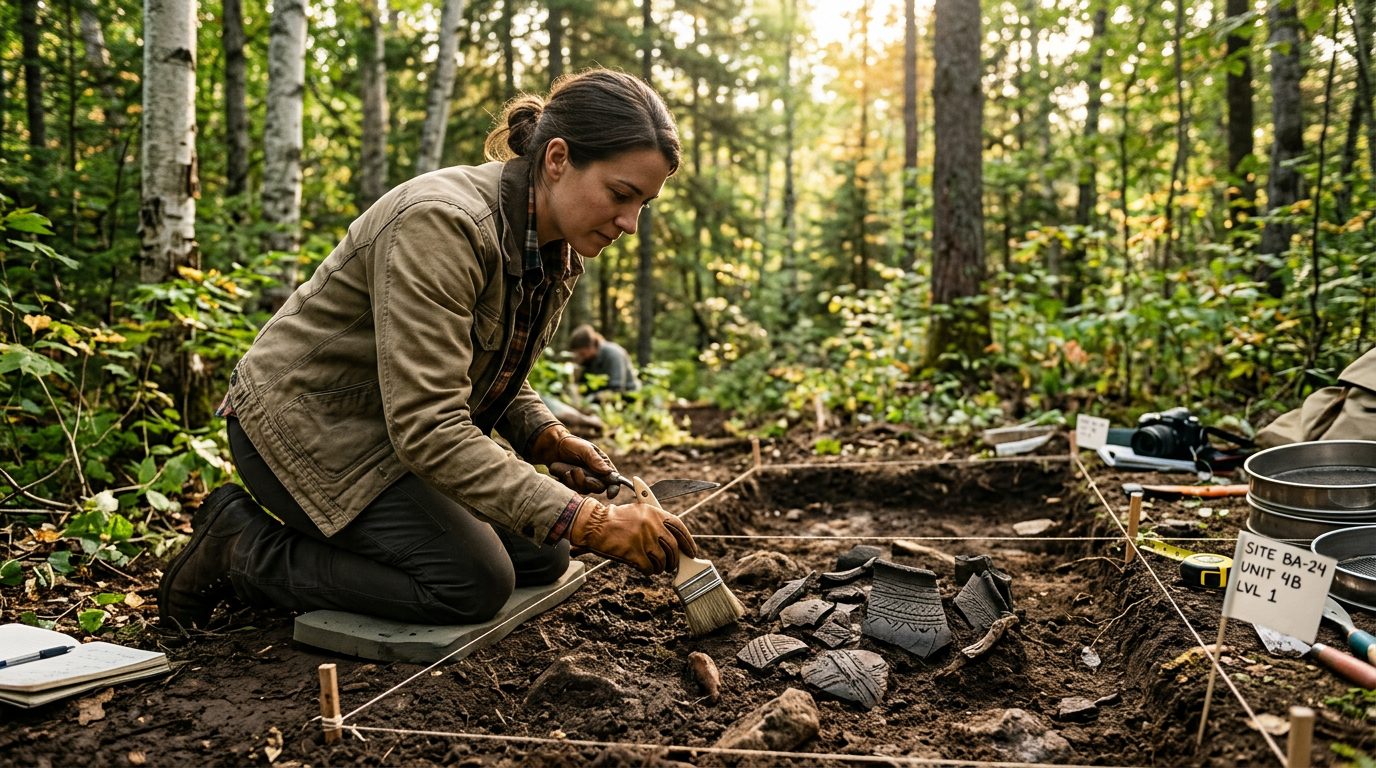
The standard account of human habitation in what is now Canada was, for much of the twentieth century, relatively straightforward: the first peoples arrived across the Bering land bridge from Asia approximately 13,000 years ago, during or shortly after the last glacial maximum, and spread southward through the continent as the ice retreated. This narrative — sometimes called the "Clovis First" hypothesis, after the archaeological site in New Mexico where key evidence was first found — shaped how Canadian prehistory was taught and understood for decades.
In recent years, archaeological findings have revised this picture substantially. New sites, new dating techniques, and a genuine shift in the methodological and ethical framework of Canadian archaeology — one that increasingly incorporates Indigenous oral histories and knowledge as legitimate sources of evidence — have produced a more complex, older and in many ways more remarkable account of early human life on this land.
Earlier Than We Thought: The Evidence for Pre-Clovis Habitation
The most significant recent revisions to the standard narrative concern timing. A site at Bluefish Caves in the Yukon, excavated over several decades by archaeologist Lauriane Bourgeon and her colleagues, has yielded bone fragments with cut marks indicating human butchering activity — dated using advanced radiocarbon techniques to approximately 24,000 years ago. If confirmed, this would place humans in the Yukon at a time when the Bering land bridge was open but the southern migration routes through North America were blocked by ice.
The implications are significant. If people were present in what is now Canada 24,000 years ago, they could not have migrated southward through the interior of the continent by the route that the standard model requires. This has revived serious academic interest in the "coastal migration" theory — the hypothesis that early arrivals followed the Pacific coastline southward by boat, moving along the ice-free edges of glaciers rather than through the interior. Evidence for this route is difficult to find archaeologically because the coastlines in question are now submerged under ocean water that was released as the glaciers melted — but the logic is increasingly compelling.
The Complexity of Pre-Colonial Societies
A second major revision concerns the nature and complexity of the societies that inhabited Canada before European contact. Earlier accounts tended to describe these societies in terms that implied relative simplicity — small, mobile bands of hunter-gatherers in most regions, with the notable exception of the more complex chiefdoms of the Pacific Northwest coast. Recent archaeology has significantly complicated this picture.
Excavations at the Keatley Creek site in British Columbia, associated with the Secwépemc people, have revealed a large village settlement with semi-subterranean pithouses that may have housed hundreds of people and been occupied for extended periods. The scale and organisation of the site implies social and economic complexity — including significant salmon harvesting and storage operations — that goes well beyond the "simple forager" model.
Similarly, work in the Great Plains has revealed evidence of extensive and sophisticated bison hunting practices — including large-scale communal drives that required coordination across significant groups — that challenge earlier assumptions about the scale of social organisation in the pre-contact interior.
"The revised account of pre-colonial Canada is not simply older — it is richer, more socially complex and more deeply rooted in the land than the standard narrative suggested."
The Role of Indigenous Knowledge in Archaeological Practice
One of the more significant shifts in Canadian archaeology over the past two decades has been the growing integration of Indigenous oral histories, traditional ecological knowledge and community involvement into archaeological research. This shift is partly ethical — a response to the long history of archaeological practice that treated Indigenous peoples as subjects of study rather than participants in the production of knowledge about their own heritage.
But it has also proven methodologically productive. Indigenous oral traditions in many communities contain detailed accounts of events, landscapes and practices that, when examined alongside the material record, have pointed archaeologists toward sites and interpretive frameworks that they might not have found or considered independently. The coastal migration theory, for instance, resonates with oral traditions in several Pacific coast communities that describe their ancestors as maritime people from a very early period.
What is emerging from this more collaborative approach is a picture of pre-colonial Canada that is neither the pristine wilderness of the colonial imagination nor a straightforward extension of patterns familiar from the post-contact period. It is, instead, a picture of diverse, adaptive and sophisticated human societies occupying an extraordinary range of environments over a period of time that is almost incomprehensibly long — and that has only recently begun to be understood on anything approaching its own terms.