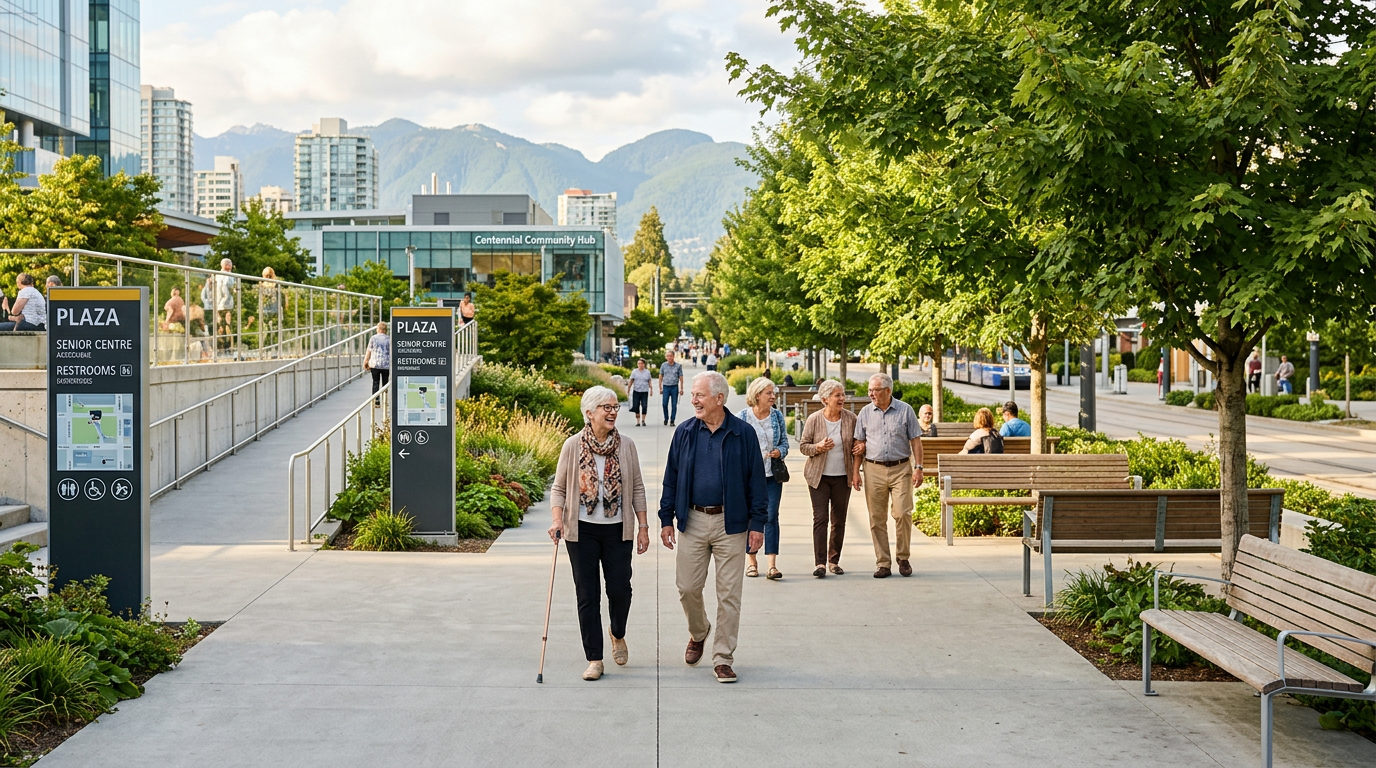
By 2030, one in four Canadians will be over the age of 65. This is not a projection that catches planners by surprise — the demographic shift has been anticipated for decades, and its implications for urban design are now being actively worked through in cities across the country. What is becoming clear, as these conversations move from policy documents to actual built environments, is that designing cities for aging populations produces benefits that extend well beyond older residents. The changes that make urban environments work better for people over 65 tend to make them work better for almost everyone.
This insight — sometimes described as the "curb cut effect" in urban planning literature, named for the experience of finding that curb cuts installed for wheelchair users benefit cyclists, delivery workers, parents with strollers and countless others — is reshaping how Canadian municipalities approach everything from sidewalk design to public transit to housing density. The design principles that age-friendly urbanism is producing are, in effect, principles of better urbanism generally.
The WHO Age-Friendly Cities Framework
Canada has been an active participant in the World Health Organization's Global Network for Age-Friendly Cities and Communities since its establishment in 2010. The framework identifies eight domains of age-friendly urban life: outdoor spaces and buildings, transportation, housing, social participation, respect and social inclusion, civic participation and employment, communication and information, and community support and health services.
What makes the framework practically useful is that it provides a structured basis for municipal self-assessment — cities can evaluate their performance against each domain and identify specific areas where physical or policy changes would make the greatest difference. Many Canadian municipalities, including Toronto, Ottawa, Montréal, Vancouver and a range of smaller cities, have undertaken formal age-friendly assessments and published action plans with specific commitments.
Sidewalks, Seating and the Overlooked Infrastructure of Movement
The most immediately impactful changes in age-friendly urban design tend to be surprisingly modest in scale. Research consistently identifies walking as the primary mode of physical activity for people over 60 — and the quality of the walking environment as one of the most significant determinants of how much people walk, and therefore of how active, independent and socially engaged they remain.
- Sidewalk continuity and surface quality. Cracked, uneven or missing sidewalks create significant barriers for older pedestrians, particularly those using mobility aids. Many Canadian cities have discovered, through age-friendly audits, that their sidewalk networks contain significant gaps in lower-density residential areas that have received less infrastructure investment over decades.
- Seating availability. Research by gerontologist researchers at the University of Toronto found that the availability of public seating at regular intervals — approximately every 100 metres — significantly increases the distance that older pedestrians are willing to walk from their homes. Many Canadian streetscapes have almost no public seating outside of park environments.
- Curb cut quality and placement. Even where curb cuts exist, their placement and quality vary enormously. Well-designed curb cuts — flush with the road surface, clearly delineated, appropriately placed — reduce fall risk and increase confidence for older pedestrians.
Transit Design and the Mobility Gap
For Canadians over 70 who no longer drive — either by choice or necessity — the quality of public transit is not a convenience issue. It is a determinant of social participation, access to services and independent living. The gap between the transit systems that most Canadian cities have built, and the transit systems that would genuinely serve older non-drivers, is significant.
Specific design elements that research identifies as particularly important for older transit users include: low-floor buses and trains that eliminate the need to climb steps, audio announcements of stops at audible volumes, seating near doors with clear priority labelling, and transit information displays that are legible at normal reading distances without requiring close approach. Many of these elements are now standard in newer transit vehicle procurement; older fleets often lack them entirely.
"Designing cities for aging populations produces benefits that extend well beyond older residents. The changes that make urban environments work better for people over 65 tend to make them work better for almost everyone."
Housing and the Challenge of "Aging in Place"
Survey research consistently finds that the strong preference of most older Canadians is to continue living in their homes and communities as they age — what planners and gerontologists call "aging in place." Supporting this preference requires both housing stock that can be adapted for changing physical needs, and the surrounding community infrastructure — services, social opportunities, transportation — that makes independent living genuinely viable.
The Canadian housing stock is, on the whole, poorly suited to aging in place without modification. Single-family homes built to mid-twentieth-century standards typically have multi-level floor plans, narrow doorways, stairs to the main entrance and bathroom configurations that create significant barriers for people with reduced mobility. The renovation and retrofitting market for age-friendly home modifications has grown substantially over the past decade — and municipal planning incentives that support secondary suites, accessible renovations and intergenerational housing models are beginning to appear across the country.
What the age-friendly cities movement is producing, at its best, is not a specialised set of accommodations for a particular demographic group — it is a richer conception of what it means for a city to work well for all of its residents, across the full range of ages, abilities and life circumstances. That is a more ambitious goal than municipal planning has typically set for itself. It is also, increasingly, the goal that the changing demographics of Canadian cities require.