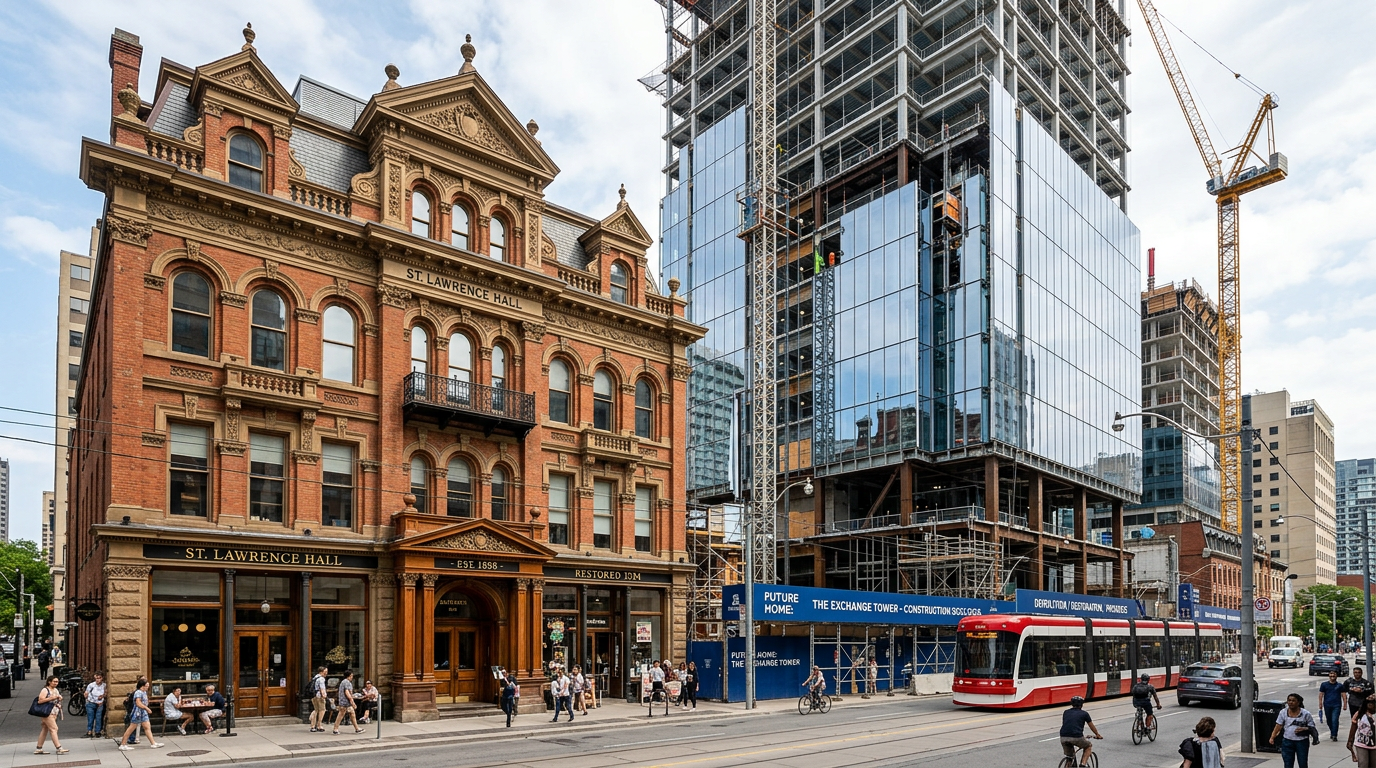
In cities across Canada, a conflict plays out regularly between the logic of development and the logic of preservation. An old building — a warehouse district, a commercial block, a mid-century civic structure — stands on land that a developer has identified as suitable for a new project. The heritage advocates argue that the building's historical character and streetscape contribution are irreplaceable. The developers argue that the new project will create housing, commercial space or community amenity that the city urgently needs. The city council deliberates, residents divide along broadly predictable lines, and a decision is eventually reached that satisfies no one completely.
This scenario has repeated itself in Vancouver's Gastown, Toronto's King-Spadina corridor, Montréal's Griffintown, Halifax's North End and dozens of smaller cities across the country. The debate it generates is genuine and substantive — not because preservation and development are inherently incompatible, but because the trade-offs involved are real, and the values at stake are ones that reasonable people weigh differently.
The Case for Preservation
The argument for architectural preservation rests on several foundations, some cultural and some economic.
- Cultural continuity and place identity. Buildings are repositories of collective memory. When a city loses its older built fabric, it loses the physical evidence of its own history — the layer by layer accumulation of different eras, different aesthetic sensibilities, different ways of using urban space. This loss is not abstract. Research consistently finds that residents of neighbourhoods with retained historical character report stronger place attachment and community identity than those in neighbourhoods that have been comprehensively redeveloped.
- The embodied carbon argument. In an era of genuine environmental concern, the demolition of existing buildings and replacement with new construction represents a significant and often underacknowledged environmental cost. The energy and materials that went into constructing a building are embedded in its fabric — demolishing it wastes that investment and creates waste streams, while new construction requires substantial new resource inputs. Restoration, by contrast, dramatically reduces the carbon footprint of urban renewal.
- Economic vitality of heritage districts. Tourism research and commercial real estate studies consistently find that well-preserved heritage districts generate significant economic activity. The Old Town districts of Québec City and Ottawa's ByWard Market area are obvious examples; less visible but equally real is the economic premium that older mixed-use commercial streets command over newer developments in many Canadian cities.
The Case for Adaptive Reuse
The most sophisticated response to the restoration versus demolition binary is to question whether it is actually binary. Adaptive reuse — the conversion of buildings from their original purpose to new uses, retaining the structure while transforming the interior — has produced some of the most successful urban regeneration projects in Canada over the past two decades.
The Distillery District in Toronto, converted from a Victorian industrial complex to a pedestrian arts and culture precinct, is perhaps the most prominent Canadian example. The SILO19 development in Montréal, which converted historic grain silos into residential and commercial space, demonstrates the model's applicability to industrial heritage. In smaller cities, former schools, churches and post offices have been converted to residential, hospitality and cultural uses with results that benefit both the heritage fabric and the contemporary programme.
"The most sophisticated response to the restoration versus demolition binary is to question whether it is actually binary. Adaptive reuse has produced some of Canada's most successful urban regeneration projects."
When Demolition Is the Right Answer
The preservation case is genuinely strong — but it is not always the right answer. Not every old building is architecturally significant. Not every heritage designation reflects a considered assessment of genuine cultural value. And the housing crisis that afflicts most major Canadian cities is real: the failure to allow sufficient new construction in established neighbourhoods is a significant contributor to housing unaffordability.
The most principled approach to these decisions involves applying a genuine hierarchy: first, ask whether the building has real heritage value. If yes, explore adaptive reuse before considering demolition. If demolition is ultimately unavoidable, require the developer to document and mitigate the heritage loss in a substantive way — through design requirements, public art, archival work or contributions to heritage conservation elsewhere in the community. What is least defensible, and unfortunately still common, is the reflex designation of buildings as heritage primarily as a tool to obstruct development, rather than as a genuine assessment of cultural significance.
The cities that navigate this tension most effectively are those that have developed clear, consistently applied frameworks for heritage assessment — frameworks that can identify genuine significance without becoming instruments of preservation for its own sake. Canada has examples of both approaches, and the difference in urban outcomes between them is visible to anyone who spends time in the cities concerned.