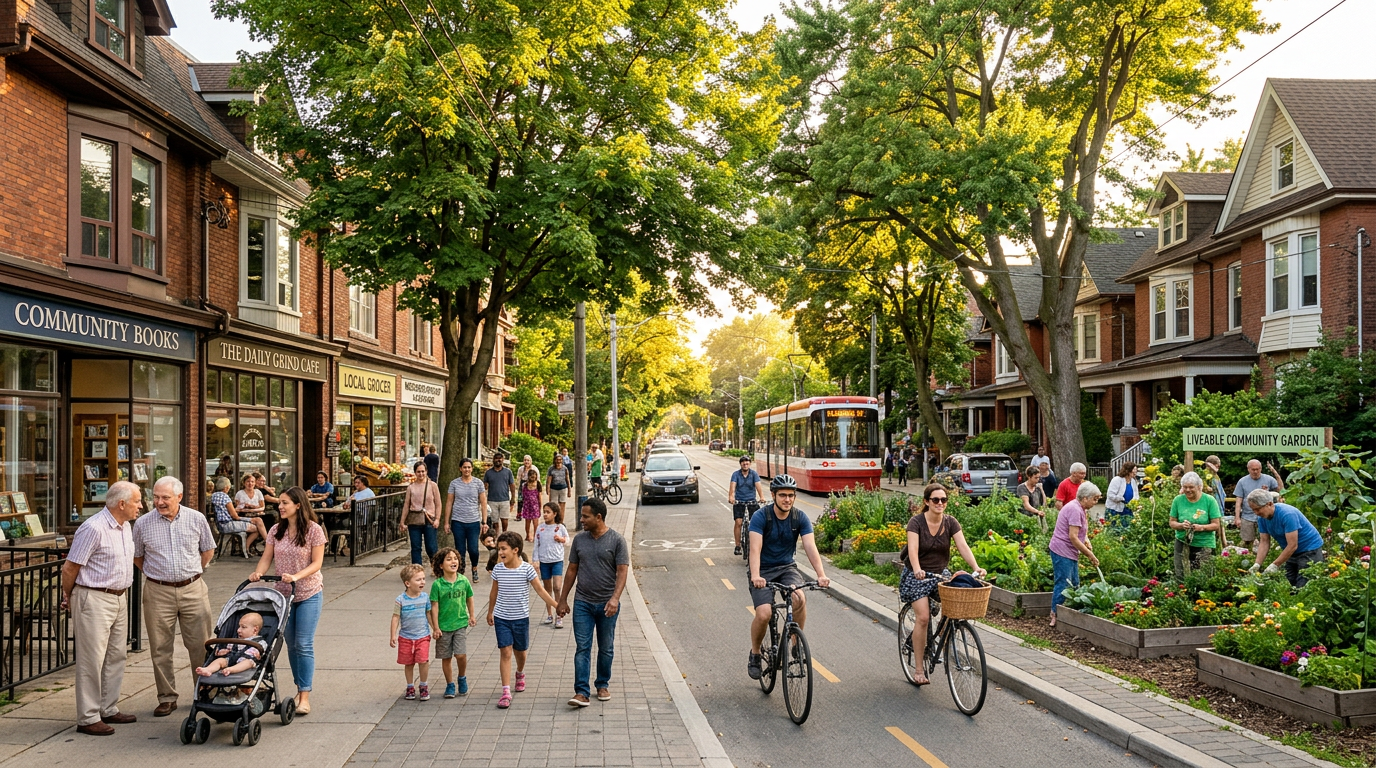
The question of what makes a neighbourhood liveable has attracted enough academic study, policy analysis and popular writing that its answer might seem settled. In practice, it is not. The elements that researchers and residents identify as most important tend to overlap without being identical; the features that appear in standard liveability indices are measurable but not always the ones that people actually point to when explaining why they love where they live. Understanding both dimensions — the measurable and the intangible — is necessary for a useful account of what genuine urban liveability looks like.
Several cities around the world have been consistently identified in both research literature and in the experience of their residents as examples of liveability done well. What they share is instructive — and relevant to the choices that Canadian cities are making about how to grow and change.
The Walkability Foundation
Every city that consistently appears in discussions of liveability shares one fundamental characteristic: it is organised around walking. This does not mean that cars are absent or unwelcome — it means that the daily needs of most residents can be met on foot or by transit, that streets are designed to be pleasant to walk in rather than merely to move vehicles through, and that the neighbourhood scale has been maintained in a way that keeps destinations within a ten-to-fifteen minute walk from most homes.
Copenhagen is the most frequently cited European example — a city that has been systematically redesigned since the 1960s to prioritise cycling and pedestrians, and that has produced, over six decades, a urban environment where the majority of residents report high levels of daily physical activity as an incidental consequence of how they get around. Melbourne, Auckland and Singapore appear regularly in research comparisons for similar reasons: cities where the street network and land use mix support active transport as the default rather than the exception.
The implications for Canadian cities are significant and somewhat uncomfortable. Most Canadian metropolitan areas outside their oldest central neighbourhoods are fundamentally car-dependent — a legacy of mid-twentieth-century planning decisions that treated the car as the primary mode of urban transport and designed accordingly. Retrofitting car-dependent suburbs for walkability is substantially more difficult than designing walkability from the start. It is not impossible — corridor intensification strategies in cities like Ottawa and Calgary are producing real results in specific areas — but it is slow and expensive work.
The Mixed-Use Imperative
Closely related to walkability is the question of land use mix. The most liveable urban environments are not segregated by use — they are places where homes, shops, workplaces, services and green space are interleaved at a scale that makes daily life spatially coherent. The post-war planning doctrine of strict use separation — residential zones here, commercial zones there, industrial zones elsewhere — produced environments that are efficiently organised in theory and profoundly inconvenient in practice.
Research by urban economist Edward Glaeser and others has consistently found that mixed-use neighbourhoods produce higher levels of resident satisfaction, stronger local economies, lower per-capita carbon footprints and more resilient communities than use-segregated areas. The cities that score highest on liveability measures consistently demonstrate this at the neighbourhood scale: the café and the grocery store and the doctor's office and the park are all within a ten-minute walk of the apartment, and the apartment is in a building that sits alongside similar apartments, which sit alongside the café and the grocery store.
The Social Infrastructure That Most Rankings Miss
Standard liveability indices — the kind produced annually by organisations like the Economist Intelligence Unit and Mercer — tend to measure things that are relatively easy to quantify: commute times, air quality, crime rates, access to healthcare. What they measure less well is the quality of social infrastructure: the density of public spaces where people actually encounter one another, the vibrancy of community institutions, the sense of neighbourhood coherence that makes people feel they belong to a place rather than simply occupying it.
"The most liveable urban environments are not merely convenient or efficient — they are places where people encounter one another, where public life has texture and warmth, and where the scale of daily experience feels human."
The cities that residents consistently describe as places they genuinely love — as opposed to places they merely rate highly on functional criteria — tend to score well on this dimension. They have public markets, community libraries, parks that are actively programmed, festivals that draw their neighbourhood together, squares that are genuinely used rather than merely existing. These elements are not accidents. They are the product of deliberate investment and planning decisions that treat social life as a legitimate urban infrastructure priority, alongside roads and sewers and transit.
Canadian cities vary substantially in how well they support this kind of social infrastructure. Montréal and Vancouver score notably well in research on resident satisfaction with neighbourhood social life. Many suburban municipalities score far less well — a finding that correlates with the physical structure of those environments, where the design vocabulary of the strip mall and the cul-de-sac does not create the conditions for the casual social encounters that underpin a sense of community. The lesson is not that suburbia is irredeemably unliveable. It is that liveability is a design outcome, not a default — and that getting it requires treating social life as something worth designing for.