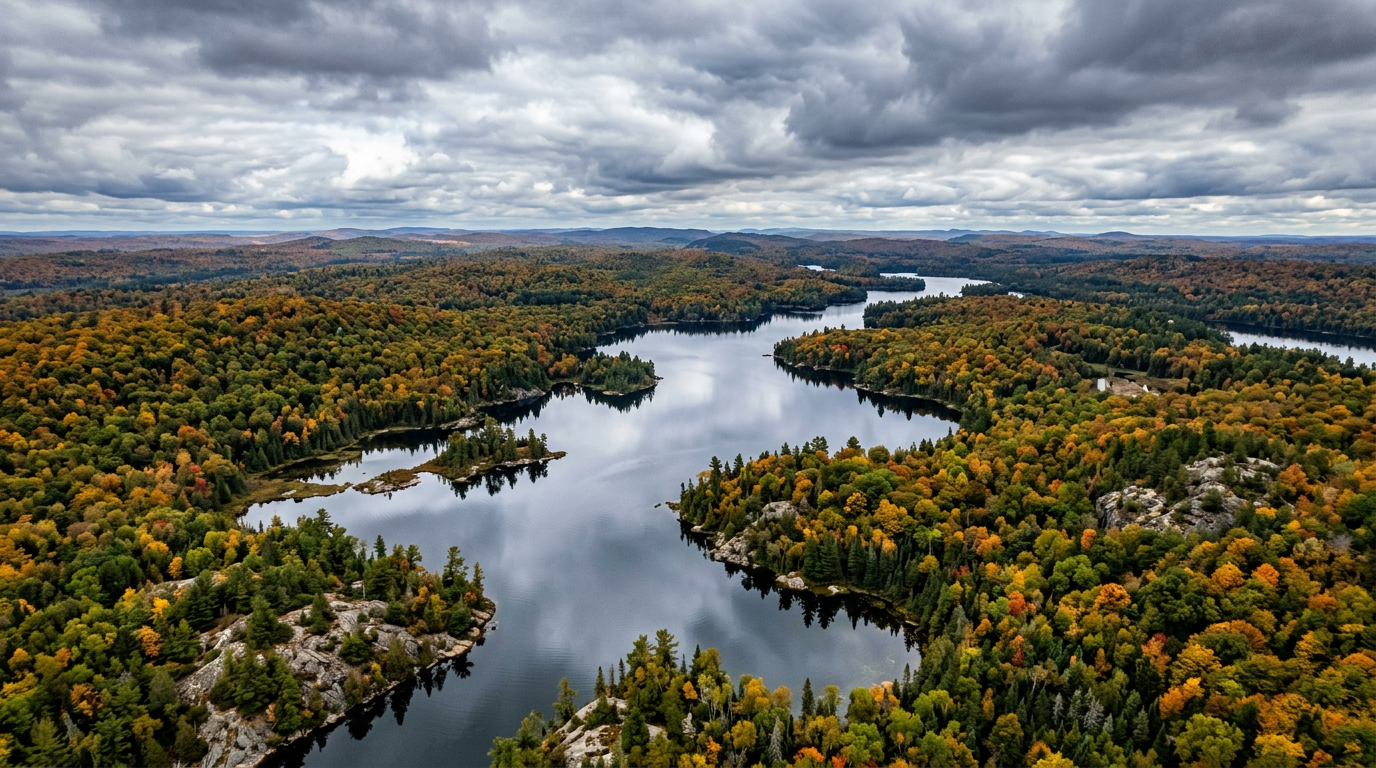
Canada is, in one sense, a country that most Canadians know only partially. The geography alone — ten provinces, three territories, a land mass that spans six time zones — makes it functionally impossible to know even a significant fraction of the country through direct experience. Yet the pattern of domestic travel tends to concentrate on a relatively small number of well-known destinations: Banff, Niagara Falls, Old Québec, the Cabot Trail. The result is that vast and genuinely extraordinary regions remain largely unexplored by people who have spent their entire lives within a few hours' drive of them.
This is not a criticism. It reflects the reality that for most of their lives, Canadians have been drawn outward — to Europe, the United States, Southeast Asia — by a cultural emphasis on international travel as the default form of significant journeying. What has changed in recent years, partly through the practical effects of global events and partly through a genuine shift in how people think about travel, is a renewed interest in what Canada itself actually contains. And that interest, once activated, tends to produce a particular kind of surprise.
The Gaspésie Peninsula, Québec
Most people who have driven through Québec are familiar with the route from Montréal to Québec City, and perhaps the Laurentians to the north. Far fewer have made the journey east along the south shore of the St. Lawrence to the Gaspésie Peninsula — a landscape of extraordinary drama, where the Chic-Choc Mountains descend toward the Gulf of St. Lawrence and the communities along the coast retain a cultural distinctness that feels genuinely removed from the urban rhythms of the province's major cities.
The Parc national de la Gaspésie offers some of the most technically accessible alpine terrain in eastern Canada, with trails that provide genuine elevation and views across a landscape that most visitors to the province do not know exists. The towns along the Baie-des-Chaleurs offer a relaxed, deeply local form of hospitality that stands apart from the well-managed tourist experience of the better-known parts of the province. The seafood — particularly the shrimp and snow crab landed at Matane and Carleton — is among the finest in the country.
The Kootenay Region, British Columbia
British Columbia tourism is heavily concentrated in Vancouver, Whistler and the Okanagan. The Kootenays — the mountainous region in the southeastern part of the province, centered on towns such as Nelson, Rossland and Kaslo — remain largely off the radar for most visitors, including many who live in the province.
What the region offers is remarkable: a combination of genuine mountain landscape, a strong arts and cultural community that developed during the counter-culture movements of the 1970s and has sustained itself in distinctive ways since, and a quality of daily life in the smaller towns that is almost entirely absent from the more populated parts of the province. Nelson, in particular, is a town that consistently surprises first-time visitors with the density of what it contains — galleries, independent bookshops, live music venues, restaurants of genuine quality — within a population of under twelve thousand people.
The Churchill Region, Manitoba
Churchill, Manitoba sits at the edge of Hudson Bay, connected to the rest of the provincial road network only by air and rail. It is, by any measure, remote. It is also one of the most remarkable wildlife destinations in the world — and one that many Canadians are aware of in the abstract without ever having seriously considered visiting.
The polar bear migration that concentrates around Churchill each autumn draws international visitors from across Europe and North America, but the region offers significant interest throughout the year. Beluga whales gather in the Churchill River estuary in summer in numbers that make close-water observation possible in ways that few other places on earth allow. The aurora borealis, visible for much of the year at this latitude, is accessible without the need for expensive Nordic expeditions.
"The pattern of Canadian domestic travel tends to concentrate on a small number of well-known destinations. The extraordinary regions beyond them remain largely unexplored — often by people who live within a few hours' drive."
The Annapolis Valley and Cape Breton Highlands, Nova Scotia
Nova Scotia is perhaps the most consistently underestimated province in Canada for domestic travel. The Cabot Trail is well-known; the interior of Cape Breton, and the Annapolis Valley to the west, are considerably less so. The Valley — a long, fertile corridor between the North and South Mountains — has developed a wine and food culture in recent years that rewards extended exploration, while the Scots Gaelic heritage of the interior Cape Breton communities offers a cultural depth that is genuinely unusual in North America.
What connects all of these regions is a quality that the well-travelled routes through Canada often fail to provide: the experience of genuine discovery. The traveller who arrives in Nelson or Gaspé or Churchill without a fully formed expectation of what they will find tends to leave with something that curated tourism experiences are specifically designed to deliver but rarely achieve — a sense of having found something, rather than simply having consumed it.